
An audit revealed that suspected PFS reports may be overlooked because of how they’re classified in drug-safety databases. Our coalition secured the addition of “Post-finasteride syndrome” as an official MedDRA term.
November 9, 2026
Dear Friends:
If you’ve long believed that drug regulators have been painfully slow to investigate persistent adverse reactions attributed to finasteride, you’re not alone. Since our 2012 inception, thousands of men suffering from PFS, along with more than 100 doctors treating it, have shared that same concern with us.
Now we’re asking all of you to help address a serious gap in how the condition is reported and identified in drug-safety databases. The task is simple: Beginning immediately, anyone reporting persistent adverse reactions following finasteride use should continue to include each individual symptom but also identify the overall condition as “Post-finasteride syndrome.”
What’s far less simple are the whos, whats, whens and wheres of using standardized medical terminology, known as MedDRA, to code adverse reactions in drug-safety reporting systems. So we’ve developed this Q&A to bring everyone up to speed.
Understanding MedDRA
Q1: What does “MedDRA” stand for?
A: Medical Dictionary for Regulatory Activities. It’s an internationally used standardized medical terminology that helps drug regulators, pharmaceutical companies, and healthcare professionals describe, classify, and analyze medical information, particularly suspected adverse reactions to prescription and over-the-counter medications. One patient, for example, might report “loss of sex drive” while another reports “decreased libido”—two virtually synonymous terms. MedDRA provides standardized terminology that helps drug-safety experts organize and analyze such reports consistently.
Q2: Does any one nation own or control MedDRA?
A: No. MedDRA is an international medical terminology developed under the International Council for Harmonisation of Technical Requirements for Pharmaceuticals for Human Use (ICH). The nonprofit organization brings together pharmaceutical regulatory authorities and industry representatives to develop harmonized standards for the safety, quality, and efficacy of pharmaceutical products. MedDRA operates through this international framework rather than being controlled exclusively by any individual country.
Q3: Who maintains and updates MedDRA?
A: While MedDRA is overseen by ICH—which establishes policies and provides overall direction for its development and use—the system is maintained and updated by the Maintenance and Support Services Organization (MSSO). Unlike ICH, MSSO is not an independent nonprofit organization. Under contract to ICH, it’s operated by Peraton, a for-profit technology and government services company based in Reston, Virginia.
Q4: How long has MedDRA coding been in use?
A: First released in 1999, MedDRA has been used for more than 25 years. In that time, it has become an important international standard for organizing and analyzing information about medication safety. MedDRA is updated twice annually to accommodate new medical knowledge and terminology. The latest MedDRA release, launched September 2026, is Version 29.1.
Coding Across the Globe
Q5: Is MedDRA the only coding system used by drug regulators?
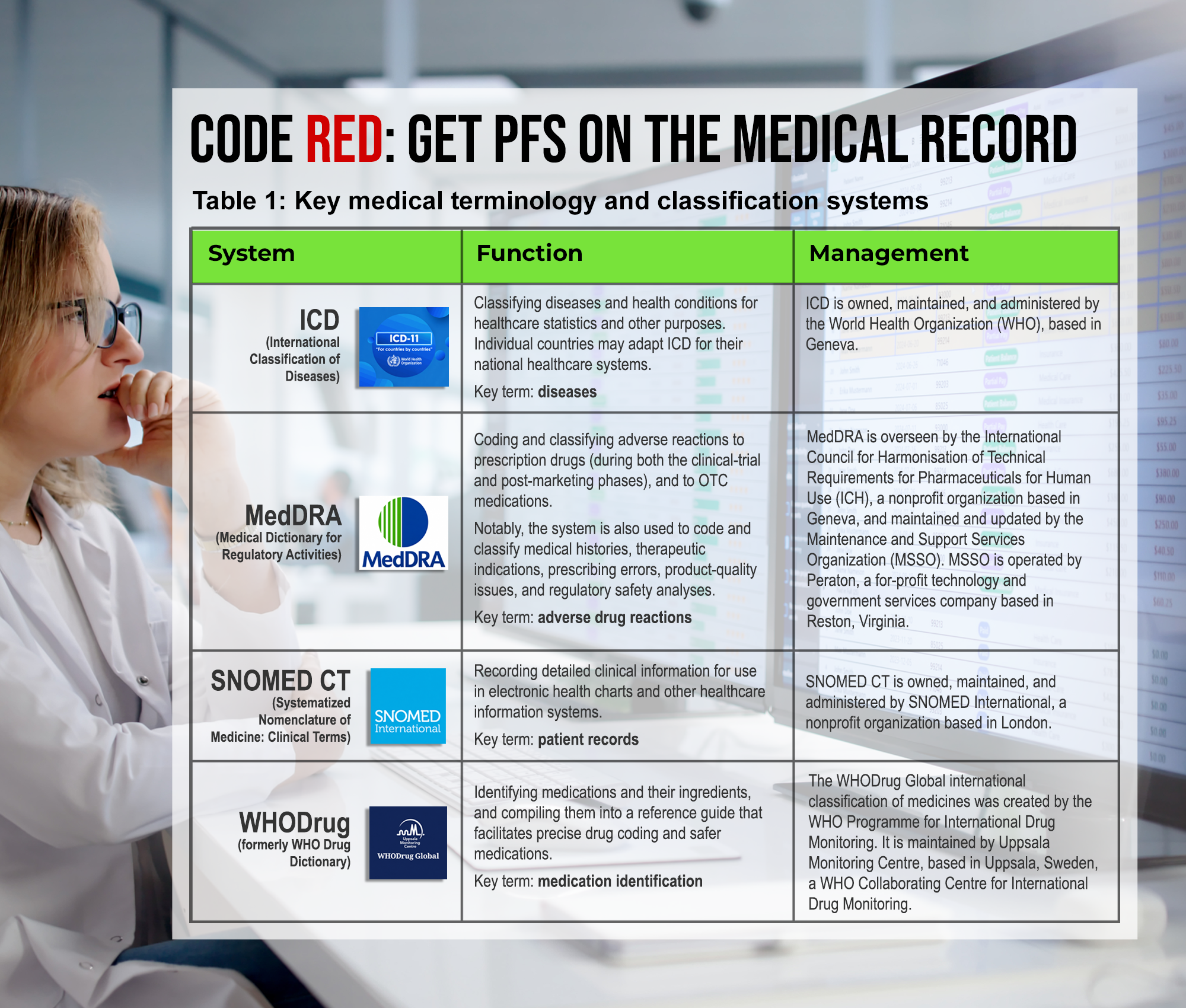
A: No. Although ICH reports having more than 9,000 organizations across 144 countries subscribing to MedDRA, other medical terminology and classification systems exist. Some are designed to classify diseases, others to record diagnoses in patient medical records, and still others to identify specific medications. Depending on their purpose, these systems may be used alongside MedDRA. Table 1 compares four commonly used systems: ICD, MedDRA, SNOMED CT, and WHODrug Global.
Q6: If MedDRA has subscribers in 144 countries, does that mean other countries don’t use it?
A: Not necessarily. The number of countries with MedDRA subscribers doesn’t tell us how many national drug regulators require or use MedDRA. Some national regulators require MedDRA for particular regulatory submissions. Others may use different terminology systems, particularly where national reporting systems were established prior to MedDRA becoming widely adopted. Differences in resources, regulations, technology, and established reporting practices can also affect adoption. Patients can check their regulator’s reporting instructions or contact the authority to ask which medical terminology system it uses.
Accurately Reporting PFS
Q7: Who assigns MedDRA codes to reports of suspected adverse drug reactions (ADRs)?
A: There’s an important distinction between submitting an adverse event report and assigning a MedDRA code to that report. Doctors, pharmacists, other healthcare professionals, patients, and attorneys acting on behalf of patients can submit reports of suspected ADRs. However, the person submitting the report typically does not assign the MedDRA code. Instead, trained personnel working for drug regulators, pharmaceutical companies, or organizations that process safety reports generally review the information and select the appropriate MedDRA terminology. Even if your doctor documents PFS in your medical record, the organization processing an adverse event report may independently determine which MedDRA terms to assign.
Q8: Should I report suspected adverse reactions to my doctor or my nation’s drug regulator?
A: Ideally, both. Your doctor can evaluate your symptoms, recommend appropriate care, and document them in your medical record. Your nation’s drug-regulatory authority (DRA) collects suspected adverse reaction reports to help monitor medication safety. If you need medical attention, contact your doctor first. Otherwise, you can report directly to your DRA without waiting for your doctor to confirm that finasteride caused your symptoms, provided your country allows patients to report directly. If your doctor has already submitted a report, ask for its reference number and include it when contacting your DRA. The authority can advise whether to submit a separate patient report or provide additional information to the existing one.
In the U.S., patients can report suspected adverse reactions directly to the Food and Drug Administration (FDA) through its MedWatch program. Other countries have their own reporting procedures. Some allow patients to submit reports online, while others may require reports to go through healthcare professionals or other designated channels.
You generally don’t need to prove that finasteride caused your symptoms before reporting them. Adverse-event reporting systems are designed to collect information about suspected drug reactions, including those for which a causal relationship has not been established.
Q9: Are doctors legally required to report suspected ADRs to national drug regulators?
A: Not always. Reporting policies vary by nation, and in many jurisdictions, individual doctors are encouraged—but not generally legally required—to report suspected ADRs. Certain serious reactions, hospital settings, or clinical research activities may be subject to mandatory reporting requirements. So patients shouldn’t assume that discussing suspected PFS with their doctor means a report will be submitted to their national drug regulator. We recommend you ask your doctor whether a report was filed and, if so, request its reference number. Where direct patient reporting is permitted, you can also contact the regulator yourself.
Q10: How can I help ensure my PFS report is coded accurately?
A: When submitting an adverse event report, clearly identify your suspected condition as “Post-finasteride syndrome,” using that exact spelling. Also include:
• The name of the medication, including whether you used finasteride or a brand-name version.
• The dosage and approximate dates you started and stopped taking it.
• Each persistent symptom you’ve experienced, including sexual, physical, neurological, or psychological symptoms.
• When each symptom began, whether during or after finasteride use, and how long it persisted after treatment ended.
• Any other medications or supplements you used while taking finasteride, including prescription and over-the-counter products.
• Any relevant medical evaluations or supporting documentation related to adverse reactions to finasteride.
Add this statement as well:
“I am reporting suspected Post-finasteride syndrome, including the individual symptoms described above. The term ‘Post-finasteride syndrome’ has been approved as a MedDRA Lowest Level Term (LLT) under the Preferred Term (PT) ‘Post 5-alpha-reductase inhibitor syndrome.’ I request that this terminology be considered when coding my report.”
That will give the organization processing your report a clear indication of the terminology you want it to consider. Simply requesting a particular MedDRA term, however, doesn’t guarantee that it will be assigned. Coding decisions are made by the organization processing the report, based on the information provided and the terminology version in use.
Q11: Can I verify how my report was coded?
A: Possibly, depending on your country’s reporting system and the organization that processed your report. After submitting a report, ask for an acknowledgment or reference number and retain a copy of the information you submitted. You can then contact the receiving organization, provide that reference number, and ask whether it can confirm in writing: (a) whether your country’s drug regulator is currently using MedDRA Version 29.1 (the first to include the LLT “Post-finasteride syndrome”), and (b) which MedDRA version was used to code your report, and which LLT and PT were assigned. Some organizations may provide this information, while others may not disclose their internal coding decisions. Keep in mind that a report acknowledgment or reference number confirms receipt of your report but does not necessarily confirm how it was coded.
Q12: Does the addition of “Post-finasteride syndrome” to MedDRA mean that drug regulators officially recognize PFS as a medical condition?
A: Not necessarily. The addition means that “Post-finasteride syndrome” has been accepted as standardized terminology within MedDRA. It does not, by itself, mean that a drug regulator has formally recognized PFS as a distinct diagnosis or determined that finasteride causes it.
The approval is nevertheless significant because it provides drug-safety professionals with a standardized term for identifying suspected PFS in adverse event reports. Its practical impact will depend on whether and how reporting organizations use the term.
Q13: Can patients who reported PFS symptoms prior to the addition of Post-finasteride syndrome as a MedDRA LLT update their reports now?
A: Potentially. Patients who previously reported suspected PFS can contact their national drug regulator to ask whether supplementary information may be submitted or the original coding reviewed. They should provide, if available:
• The reference number of their original ADR report.
• Their finasteride-use history.
• A description of their persistent symptoms.
• A statement identifying the suspected condition as “Post-finasteride syndrome.”
Patients who reported their symptoms only to a doctor should ask whether a regulatory report was ever submitted. If not, they can consider submitting one themselves, where permitted.
The PFS Foundation encourages patients who previously reported suspected PFS to follow up with their national drug regulators and request consideration of the newly approved MedDRA terminology. However, regulators are not necessarily required to recode historical reports and their procedures vary by country.
Egregious Discrepancies
If you’ve been following closely, you probably noticed, in Q10, that “Post-finasteride syndrome” has been approved as a MedDRA LLT under the PT “Post 5-alpha-reductase inhibitor syndrome.” You’re also probably wondering how and when that came about, to say nothing of what LLTs and PTs are. If so, read on.
About a year ago, Dan Demers, founder of the PSSD Network, called PFS Foundation President Philip Recchia to discuss a growing concern he suspected was common among both PFS and post-SSRI sexual dysfunction (PSSD).
“How many PFS patients do you have on file in Canada?” Demers asked.
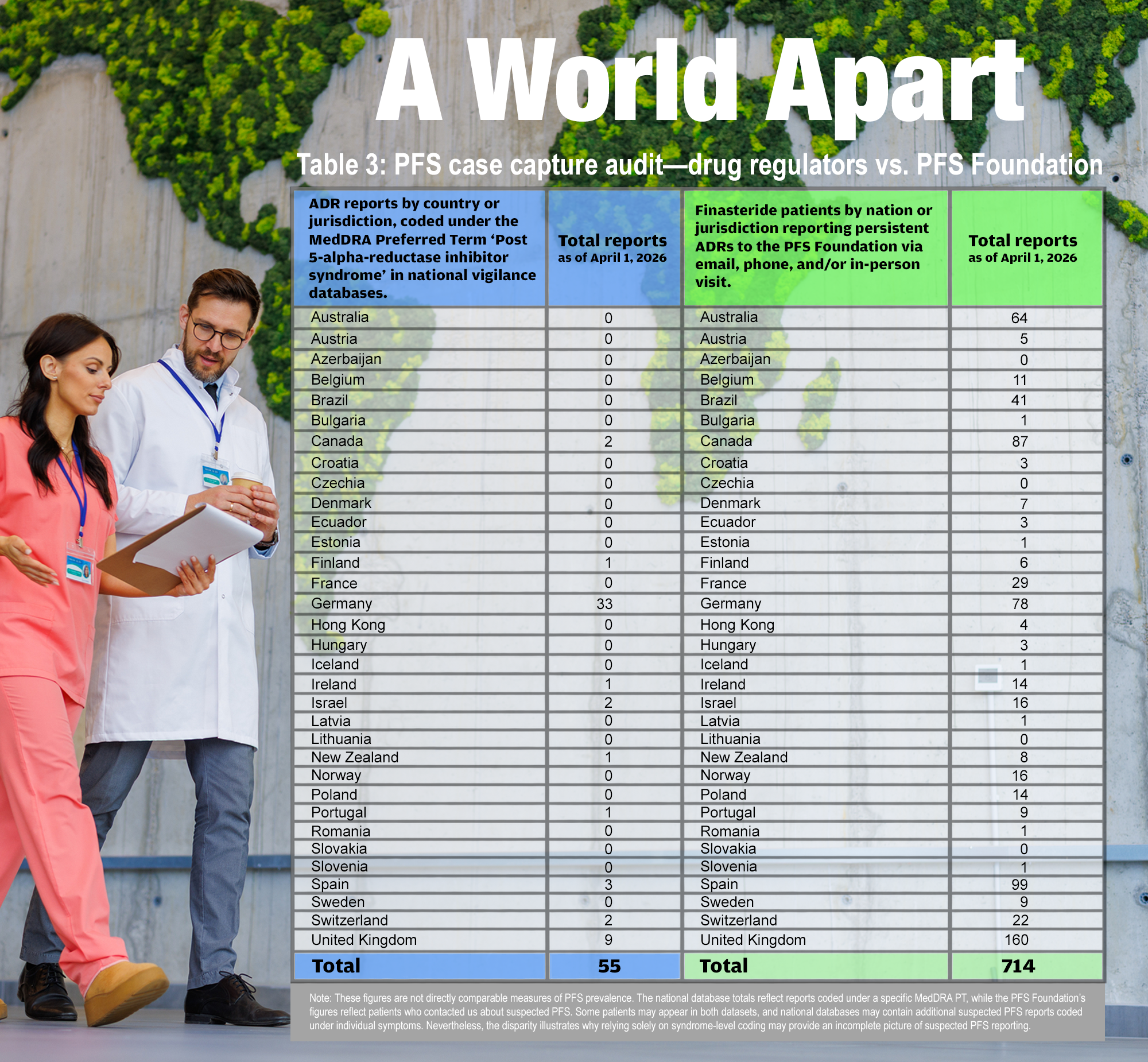
“Ahhh…” Recchia stalled while running a report in the PFS Foundation’s database, “Eighty-seven. Why?”
“Health Canada’s Vigilance Database contains only two cases coded as ‘post 5-alpha-reductase inhibitor syndrome,’” Demers said.
“Doesn’t surprise me,” Recchia replied. “No one calls it that. Did you check post-finasteride syndrome or PFS?”
“That’s the problem,” Demers said. “MedDRA—which Health Canada uses to code—doesn’t contain either of those terms. Just ‘post 5-alpha-reductase inhibitor syndrome.’”
Although the two figures represent different kinds of records and cannot be directly compared, the discrepancy raised an important question: How many suspected PFS reports might go undetected because they were coded under individual symptoms rather than the syndrome itself?
Since MedDRA is the leading international standard for coding and analyzing suspected adverse drug reactions, inconsistent terminology could make it difficult to identify and analyze reports explicitly describing PFS. This problem may extend beyond national databases to international pharmacovigilance systems such as the WHO’s VigiBase.
With that realization, the PFS Foundation joined forces with the PSSD Network and France’s Aide aux Victimes du Finastéride (AVFIN) to investigate further. Demers and his team set about auditing pharmacovigilance databases in 32 additional nations and jurisdictions, all of which use MedDRA to code ADRs. In some cases, those databases are publicly available via the regulators’ websites. In other cases, the team needed to submit freedom-of-information requests to access the data, thus turning this “quickie” project into a five-month endeavor.
Term Limits Be Gone
Along the way, Demers recruited SIDEfxHUB, our mutual fundraising and awareness partner in Europe, to help. And so the registered charity did—bigtime.
In April, SIDEfxHUB founder Gary Shields, a U.K.-based attorney whose son has suffered from PFS, petitioned MSSO to add both “Post-finasteride syndrome” and “PFS” as LLTs under the existing PT, “Post 5-alpha-reductase inhibitor syndrome.”
Two months later, MSSO declined to add the acronym “PFS,” explaining that it was ambiguous, but approved “Post-finasteride syndrome” as a new LLT under the existing PT. To understand what this means, let’s look at the full range of MedDRA terms.
In all, MedDRA has five hierarchical term levels:
1) System Organ Class (SOC): The broadest classification of medical concepts, generally organized by body system or another major category.
2) High Level Group Term (HLGT): Groups related High Level Terms.
3) High Level Term (HLT): Groups related Preferred Terms.
4) Preferred Term (PT): Represents a distinct medical concept, such as a condition, symptom, or diagnosis.
5) Lowest Level Term (LLT): The most specific terminology level, including synonyms, alternative expressions, and closely related terms linked to a PT.
So, say a patient tells his doctor he’s “feeling queasy” after taking a certain drug. The doctor notes those details in the patient’s chart. From there, assuming the patient and/or doctor files a report with the local drug regulator (see Q8 for more details), a trained coder searches MedDRA for terminology corresponding to “feeling queasy.” If “Feeling queasy” itself is an available and appropriate LLT in MedDRA, the coder may select it. If that wording isn’t available as an LLT, the coder selects another available term that accurately reflects the reported symptom. From there, MedDRA’s predefined hierarchy links that LLT to the PT “Nausea,” then automatically to the HLT “Nausea and vomiting symptoms,” then to the HLGT “Gastrointestinal signs and symptoms,” and finally to the SOC “Gastrointestinal disorders.”
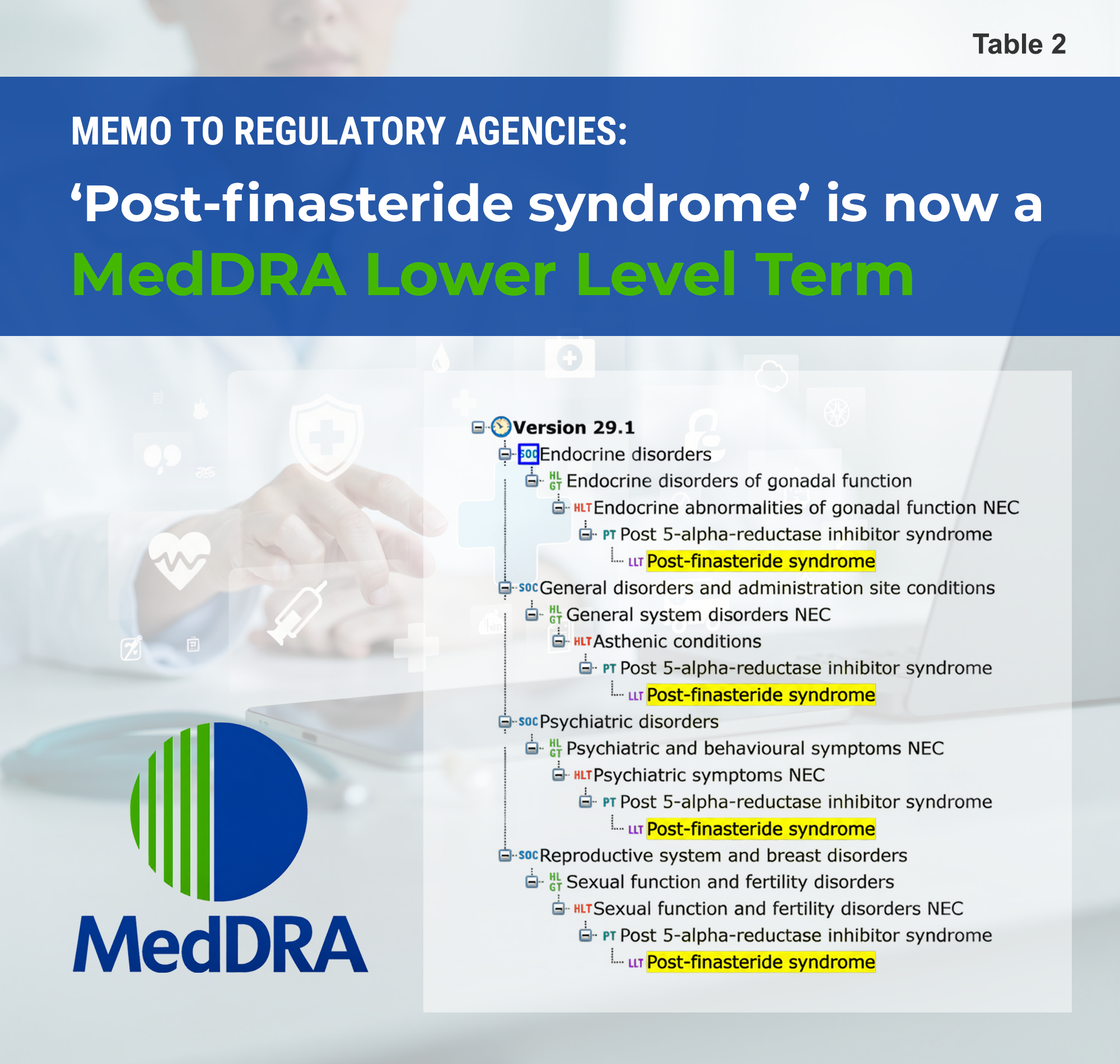
The new LLT “Post-finasteride syndrome” maps to the existing PT “Post 5-alpha-reductase inhibitor syndrome.” That PT is associated with four SOCs, reflecting the different medical categories under which the syndrome can be classified (Table 2):
• Endocrine disorders
• General disorders and administration site conditions
• Psychiatric disorders
• Reproductive system and breast disorders
Although “Post-finasteride syndrome” now has its own LLT, it remains grouped under the existing PT “Post 5-alpha-reductase inhibitor syndrome.” Consequently, databases that display only PT-level information may not separately identify reports coded using the new LLT. Its ability to improve PFS-specific searches will depend partly on whether reporting systems retain and make LLT-level information accessible.
High Hopes for Our Lower Level Term
Thanks to the PSSD Network and AVFIN Founder Sylviane Mathieu, our investigation identified ADR reports in which patients or doctors explicitly described suspected PFS, but the corresponding coded records identified only individual symptoms, such as erectile dysfunction, cognitive dysfunction, anxiety, insomnia, depression, or suicidal ideation.
Consequently, the coded records didn’t necessarily reflect the overall suspected condition—PFS. This could make such cases difficult to identify through database searches focused on syndrome-level terminology.
And as far as we can tell, relatively few reports were coded under the PT “Post 5-alpha-reductase inhibitor syndrome,” which doesn’t necessarily distinguish PFS from suspected syndromes associated with other drugs in the same class.
The number of those reports looks particularly meager when compared to those in the PFS Foundation’s own database, which has been compiled over the past 14 years (Table 3).
What’s in a Name?
At first glance, the addition of Post-finasteride syndrome as a MedDRA LLT may seem like a clerical victory—one new entry among tens of thousands in a dictionary most people will never open, let alone have ever heard of. But how a condition is named shapes what we can know about it.
“Drug-safety systems detect potential problems largely by counting. Analysts compare how often a particular term appears in reports about a specific drug with how often it appears elsewhere. A condition without a name of its own doesn’t vanish from that data. It scatters. One report calls it erectile dysfunction, another insomnia, a third depression. Each lands among thousands of reports of the same symptoms from countless unrelated causes,” Mayer Brezis, MD, Professor of Medicine (Emeritus) at Hadassah Medical Center in Jerusalem, tells us.
“What a patient experiences as a single suspected condition may be represented in the database by several individual symptom codes, without a corresponding syndrome-level designation. A pattern stored that way can be found only by someone who already knows to look for it.”
Adding a dedicated LLT can therefore make it easier to identify reports that explicitly mention suspected PFS. It does not, however, resolve the challenges of coding older records, guarantee that all regulators will use it in the same way, or replace the clinical studies needed to characterize the syndrome.
“Our hope is that this important first step will lead to more accurate reporting, help regulators identify potential drug-safety signals, encourage thorough investigations, and prompt appropriate action,” says Recchia.

Finasteride was originally developed by Merck & Co., Inc., and first approved by the US Food and Drug Administration in 1993 as Proscar (5 mg, for enlarged prostate), and again in 1997, as Propecia (1 mg, for hair loss).
In June 2021, Merck spun off its Organon subsidiary as an independent public company (NYSE: OGN). Founded in the Netherlands in 1923, Organon bills itself as a “global health care company dedicated to making a world of difference for women, their families and the communities they care for.” In April 2026, Mumbai, India-based Sun Pharmaceutical Industries agreed to acquire Organon in a deal worth $11.75 billion US.
Among the Merck products Organon acquired in the deal were Proscar and Propecia. To report adverse events for either finasteride product, call the Organon Service Center at (844)674-3200, or email Service_Center@Organon.com.
Anyone living in the US who suffers from PFS should also report his or her symptoms to the US FDA. Anyone living outside the US who suffers from PFS should report his or her symptoms to the US FDA as well as to his or her local DRA, as directed on our Report Your Side Effects page.
If you or a loved one are suffering from PFS, and feeling depressed or unstable, please don’t hesitate to contact the PFS Foundation as soon as possible via our Patient Support hotline: social@pfsfoundation.org
Thank you.